This blog article was written by Mr. Jason Dunn, a geography teacher at the International School of Lyon, France with 32 years of teaching. He teaches as part of the International Baccalaureate and International General Certificate of Secondary Education
Geography is the subject best equipped to deal with all of the world’s ‘wicked problems’ that students see in the news. We constantly look at environmental/economic/social and cultural issues worldwide and climate education as a topic is clearly of the utmost importance – after all, if we do not have a planet…(you know the rest)!
Bringing climate into the classroom
As an IGCSE and IB teacher, we HAVE to study climate issues because the topic is DIRECTLY on the syllabus.
The new IGCSE syllabus starting with the current grade 9 has ‘Climate Change’ as a new addition and the content includes natural/human CAUSES (evidence from global temperature data, ice cores, historic paintings etc. and orbital Milankovitch cycles, sunspots, volcanic activity and the enhanced greenhouse effect from the use of fossil fuels and deforestation etc.), IMPACTS/EFFECTS (rising sea levels, global temperature changes, weather patterns and food production) and RESPONSES (national/international agreements, mitigation and adaptation strategies) and one detailed specific example from a named country or region to include the impacts/responses and strategies (including sustainable ideas) in that place.
At IB level, we follow the same CAUSES/CONSEQUENCES/RESPONSES framework but in more depth (e.g. global energy balance, albedo, feedback loops, impacts on the cryosphere/hydrosphere/biosphere including animal migration patterns, extreme weather events, ocean transport routes etc. and exposure/risk/vulnerability, global geopolitics, carbon trading schemes, geo-engineering, civil society and corporate strategies with a fully detailed case study of the response in one country).
However, I would argue that climate issues should be taught in ALL areas of the syllabus as it is THAT important! Indeed, a student council survey at ISL showed that students prefer lessons where there is an element of decision-making in real place contexts.
Projects in practice
I have always tried to include an element of role-play/empathy, decision-making and gamification in certain syllabus topics.
Examples (non-climate) would include EARTHQUAKES/TECTONICS. Here, I arrange students into small groups (solo/pairs/3-5) and they are given a random set of laminated example earthquakes (Haiti 2010/Loma Prieta 1989/Tonga 2022 etc.) and they choose TWO unseen.
They then pick ONE as their study example. I then introduce the idea that they will RE-ENACT the earthquake scenario in class. They cannot change the real facts (e.g. Magnitude value/Deaths) but they can ‘invent’ local stories around something that happened (e.g. impact of an associated tsunami).
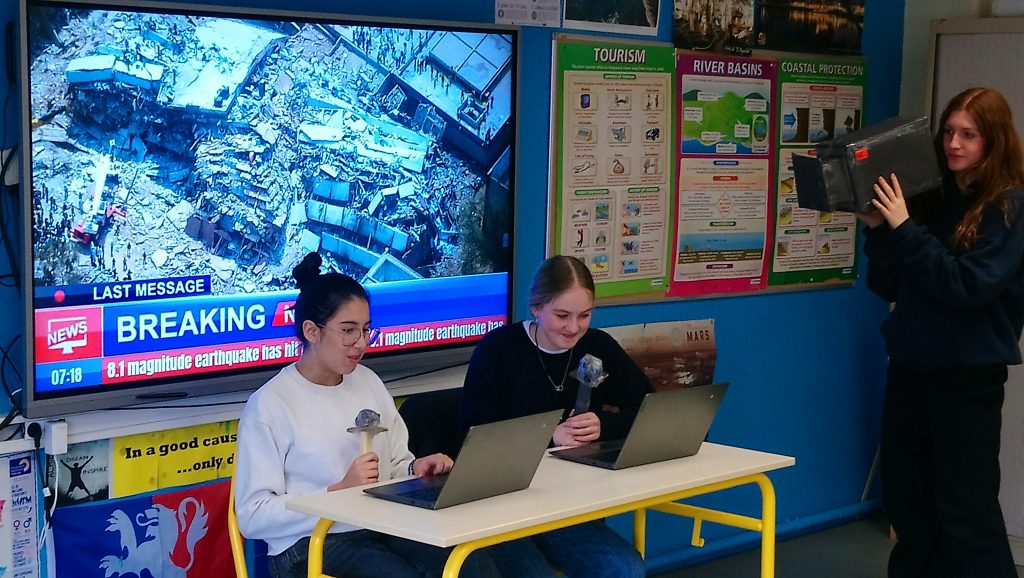
They are then told that they will represent a news team IN THE STUDIO and LIVE ‘on the spot’ and so they are encouraged in the planning/set-up lessons to think of roles, props, costume etc. and a mix of high-tech (create videos etc.) and ‘low-tech’ (acting out a rescue in class or interviewing a survivor).
Eventually, they are ready to present in a future lesson. This is done group-by-group in chronological order (to see the development of new technology for rescues etc.). I take photos for display, the other students ‘peer mark’ the geographical content/presentation quality etc. and we discuss/give feedback after each presentation.
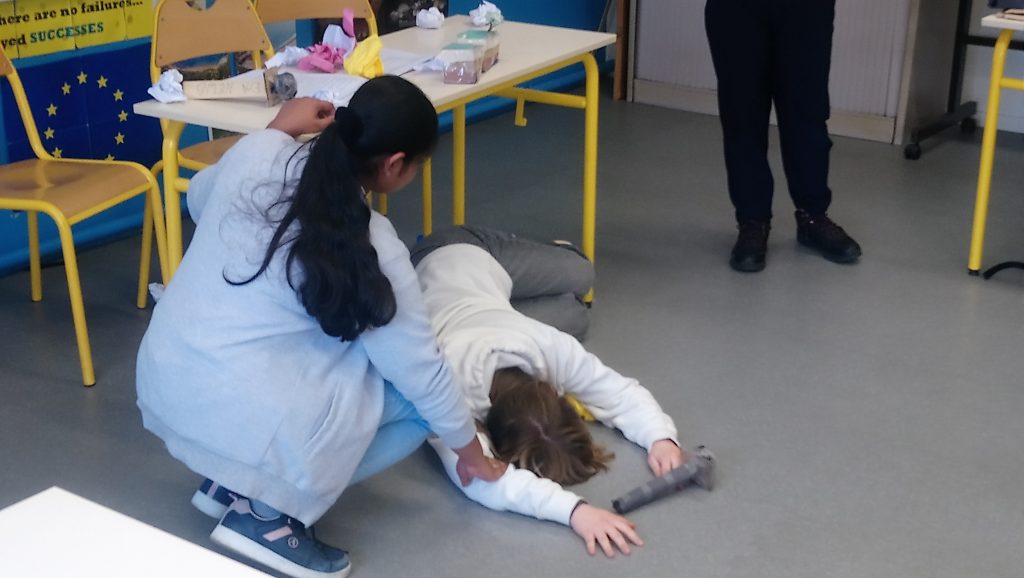
The souvenirs are created on the school wall display. Students love this approach and it is fascinating to see how they run with it. Obviously, I introduce key terminology (magnitude scales etc. ) during the planning and we look at some short video clips for inspiration (and past ideas via photos/display with the aim of improving on these ideas).
I have seen everything from students pulled from the (cardboard) ‘rubble’ using a torch, victims wrapped in blankets speaking about their ordeal via a translator, presidents arriving (causing the rescue work to temporarily halt) and full-on videos which students did themselves over a weekend involving pet rescue dogs, family members as first aid teams, integrated news channel logos/music with ‘newsflash’ updates to stories being told retrospectively as a ‘documentary’.
For FARMING, I split students into competitive teams as a farming business. They do short tasks to set up the farm (bonus points for their farm ‘name’ as voted by other staff – e.g. ‘Lamoomoo farm’, ‘Fifty shades of hay farm’, ‘Udder chaos’ farm etc., writing a letter asking for a bank loan with a business plan, choosing cow breeds based on their milk/beef characteristics), running the farm (give weather/field details…cows inside or outside? grow fodder crops? buy artificial feed?) and marketing the farm (design farm logos, websites, promotional items etc.) – all of this is gamified, with points given for successful decisions and all work can then be displayed afterwards.
This is hugely popular and successful.
For IB TOURISM, I do a decision-making group simulation of choosing the site of a ski resort and its potential impacts etc.
Climate projects in practice
For CLIMATE ISSUES, I use two examples for Grade 12 IB students (after having studied syllabus detail for causes/evidence from ice cores etc. – images of ice core drilling/ice core slices/videos etc.)
1. CAUSES/EFFECTS:
Your role is as a team of scientists looking at a selection of Antarctic ice cores from different time periods (show a lab photo/mass spectrometer etc.). You will be investigating ice core data and ‘solving’ various challenges via consensus group decision-making (gamified as ‘levels’ of challenge easy to hard levels 1-5).
e.g. Level 1 (easiest) – Why did the Vikings suddenly vanish at the end of the 14th century?
They are shown data graphs from ice core readings – Sodium concentrations in ppb in ice from 800AD to 2000AD, atmospheric temperatures over the last 2000 years vs. mean 1950 data and atmospheric methane levels in ppm.
They analyze/discuss the data (e.g. Methane rises from 0.6ppm to 1.8ppm with a steep rise after 1800) and the challenge is then shown… WHY DID THE VIKINGS SUDDENLY VANISH? Was it: A sudden drop in temperature? Stormy seas? Methane poisoning?
They work out that atmospheric temperature is not a problem for tough Vikings unless there was a massive temperature drop (not seen in the data) and methane levels are very low, but the sodium links to stormy seas.
Other gamified ‘levels’ include – When did volcanic eruptions occur? (Ice core data shows sodium/chloride/sulphate deposits) and the students match the ‘peaks’ in the data. Nuclear weapons testing – ‘when did it stop?’, and more direct climate issues like ‘Is the world really warming up? (Data shows mostly warming at different locations but also some cooling (e.g. Antananarivo, Madagascar) and there may also be ‘missing’ data years. They ‘match’ as best as possible realizing data is never always ‘perfect’. You can also ask ‘How long has the warming happened for?’ (When did the last ‘cycle’ of warming begin?) with ice core temperature data going back 400,000 years or more and weather balloon data from the 1950s onwards etc. They realize that longer-term data is more useful.
Their decisions are ‘scored’ e.g. 5/5 – You are ice core experts 4/5 – A good score, you understood most of the info.
2. RESPONSES: Tuvalu (after showing videos of Tuvalu ‘king tides’/flooding etc.)
You are a group of government advisors for Tuvalu who are trying to respond to the recent crisis of flooding/inundation/saltwater intrusion etc. and you have been contacted by a tech company called GEOTECH who are offering bespoke GEO-ENGINEERING solutions.
The students are given information and can research further e.g. Tuvalu details/Funafati/culture/facts etc. , a ‘viral’ photo of a young Tuvaluan asking ‘please prepare a place for my country to stay’, details about AOSIS (Alliance of small island states), a summary of the key impacts that Tuvalu has faced, AOSIS reports on climate change, COP21 Paris solution proposed by AOSIS etc. and a fictional ‘GEOTECH’ flyer advertising schemes such as ‘stratospheric sun shades/space-based reflectors’, ‘cloud seeding’ etc.
Students have a fixed amount of time to research/discuss and eventually have a ‘spokesperson’ who will suggest their chosen course of action (i.e. Choose one of these GeoTech options? Have a different geo-engineering option? Hybrid options? No geo-engineering at all but another option?). They need to justify their ideas (e.g. Geo-engineering is too costly/not proven to work etc.)
In the debrief, you can show them real Tuvalu videos/the COP suggestions and I then show an ‘alternative’ solution which links to the idea of ‘aggregation of marginal gains’ from Dave Brailsford (ex-Sky cycling team). In other words, show the idea that large, grandiose projects are not always the best solution. Smaller changes made by many people will ‘aggregate’ and have more impact.
Give your students agency
What makes these activities powerful and memorable is that they are full of student agency and feel ‘real’. There are too many student comments to list, but things like ‘This was amazing because I feel like I have ‘lived’ the experience’ or ‘It really allowed me to explore the issue at my own pace and I now can see a wider range of possibilities’ or ‘This made me appreciate the impacts that the Western lifestyle is causing elsewhere’ and ‘It is shocking that these people are suffering from the actions of other countries and Governments and Big Oil seem to not care, even though those people might have children of their own. Do they not want their children and their children’s children to live under better, fairer conditions’, as well as the obvious ‘That was so much fun. Much better than just reading about these issues’ etc.
Storytelling is powerful, climate is a powerful topic, and role-play/decision-making/gamification can really unlock this and galvanize students!
Reflections and lessons learned
One of the things that works so well is that you give the groups the same details/same information and just a few teaser ideas, and then they go off in so many different directions with their creative ideas. It is SO rewarding to see as a teacher. It is not surprising as I know my students are motivated but it is amazing to see how deep they go into the roles and they ‘take on’ the roles and articulate their ideas in a more ‘professional’ manner.
Climate storytelling in this way allows the students to gain new perspectives and feel that despite the often sloooooooooooooow progress (or lack of progress) from governments, there is REAL HOPE and so many people are invested in making changes happen. Everyone from educators to filmmakers to advocacy organizations like EYES/News Decoder etc. We ALL have a part to play.
As Taylor Swift said, ‘I want to be on the right side of history’…so should we and our students!
Perhaps the main challenge for teachers is ‘being willing to let go’ and cede control in the classroom. The students should be working harder than you are in many ways and these methods are more rewarding, more effective and saves your voice a little more as you are not just explaining everything yourself!
Looking ahead
We are at the end of the climate topic, but we are so happy to continue the links with EYES, News Decoder, and The Environment and Human Rights Academy, with the upcoming screening of The Cost of Growth movie and our online workshop relating to degrowth and climate justice. In other words, I want this to be LIFELONG LEARNING linked to the IB learner profile. I will also show the students some of the materials seen at the recent EYES workshop I attended in Brussels which was superb. This will help the students deepen their understanding and also have more to use in their IB exam ‘essay’ type questions.
As for other educators, climate is potentially the most important topic of all for our students. We are in a ‘NOBLE PROFESSION’ which can help with advocacy and inspire youth to create the world they want to live in. Students will not necessarily remember all of their school lessons in the future, but they will likely remember the more ‘quirky’ standout lessons like storytelling/role-play/decision-making/gamification, field trip visits etc.