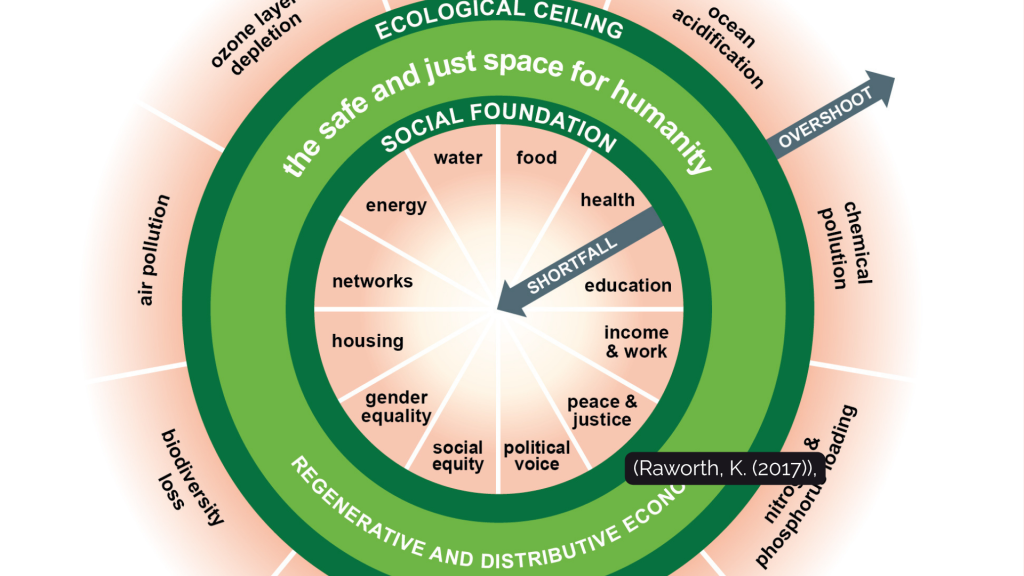
In this unit, students will analyse GDP growth and explore a new model of economy for planetary wellbeing. Topics within the unit include GDP growth and profit-centred economy, regenerative and distributive designs, what doughnut economics is, and examples of movements that fit into the doughnut economics model.
We recommend teaching this unit to students who have a good basic understanding of both climate change and economics.
Learning objectives
- Analyse the current economic system and how it relates to climate change.
- Understand the main principles and proposed solutions of the Doughnut Economics concept.
GreenComp alignment:
- Systems thinking
- Problem framing
- Futures literacy
- Exploratory thinking
This unit could be used in economics, politics, or language classes. We recommend having completed the units titled Climate Change 101, Climate Injustice, and Systemic Change before completing this unit.
Unit project:
The storytelling project is for students to “connect the dots”. This means they should identify one environmental problem (like air pollution, plastic waste, or deforestation) with one social need (such as clean water, housing, or education). They should first come up with a question that connects the two, e.g “Could increasing the number of cycling lanes decrease air pollution and increase public health?” or “What is the relationship between forest biodiversity and local community wellbeing?”
Students should then do some research to answer their question, and come up with a realistic idea or solution that helps the environment and supports people’s well-being at the same time.
Time frame:
We recommend using two classes for this unit: one to go through and comprehend the text, and another to conduct research and present findings.
The link to the lesson slides are included in the pdf
Extra resources for further reading
Fanning, A.L., Raworth, K. (2025): Doughnut of social and planetary boundaries monitors a world out of balance, in Nature 646, 47–56. https://doi.org/10.1038/s41586-025-09385-1
Kate Raworth (2017): 7 Ways to Think like a 21st Century Economist.
Doughnut Economics Action Lab (DEAL)
- Educational resources adapted to all age groups to introduce Doughnut Economics. https://doughnuteconomics.org/themes/schools-education
Regenerative economics An open-access, student-centred textbook for reimagining economics education around wellbeing within planetary boundaries, with enough material for a 2-year course. https://www.regenerativeeconomics.earth/home